Across the insurance industry, carriers are at a critical inflection point in how they adopt Agentic AI. What was once experimental is now becoming foundational. The decisions made today will shape operational models, competitive positioning, and long-term growth.
This transformation is not limited to underwriting. It spans the full enterprise-from submissions and claims to servicing and customer engagement. Every workflow that begins outside the core system and ultimately lands within it is being redefined.
Despite this shared reality, we see two very different strategic approaches emerging.
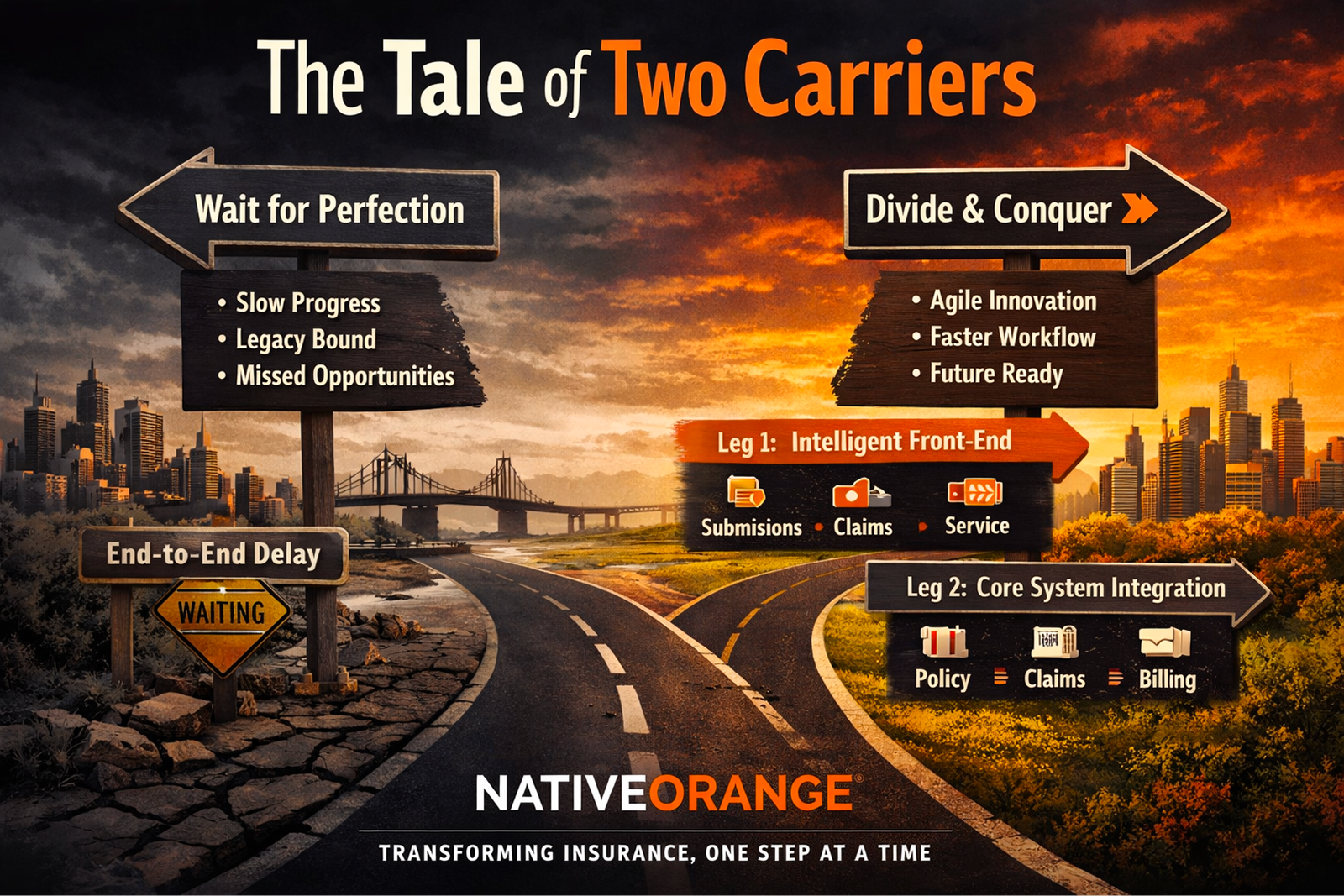
Choice 1: Wait for End-to-End Perfection- A segment of carriers is choosing to wait for fully mature, end-to-end Agentic workflows that seamlessly integrate with their existing RQI, PAS, and claims platforms. The thinking is straightforward: implement once the ecosystem is complete and proven.
While this may appear prudent, it introduces several structural risks:
- - Innovation becomes dependent on the pace of legacy systems
- - Organizations miss the opportunity to build early operational expertise
- - Data readiness efforts are delayed, compounding future complexity
- - Competitive advantages are quietly eroded over time
In a market where speed and responsiveness matter, waiting is not a neutral decision-it is a strategic trade-off.
Choice 2: Separate the Journey into Two LegsLeading carriers are adopting a more pragmatic and future-ready approach by separating transformation into two distinct legs.
Leg 1: Peripheral Agentic Workflows (High-Impact Zone)
This leg focuses on workflows that originate outside the core systems:
- - Agent to submission intake and preselection in underwriting
- - Insured to FNOL and triage in claims
- - Customer and agent service interactions across channels
This is the operational edge of the enterprise, where the highest levels of friction-and opportunity-exist.
Agentic AI delivers significant value in this layer:
- - Intelligent intake and contextual data capture
- - Real-time enrichment using internal and external data sources
- - Dynamic decisioning such as appetite checks, triage, and routing
- - Continuous learning through feedback loops and workflow evolution
Equally important, this is where organizations build the muscle memory required to operate alongside AI-learning how to trust outputs, manage exceptions, and continuously refine processes.
Leg 2: Integration into Core Systems (Completion Layer)
The second leg focuses on translating structured, validated outputs into core systems:
- - Policy administration systems (RQI/PAS)
- - Claims management platforms
- - Billing and downstream operational systems
This completes the transaction lifecycle but typically delivers lower Agentic ROI.
This is because:- - Core systems are highly structured and constrained
- - Much of the work is deterministic (mapping, formatting, validation)
- - Human oversight often remains part of the process
This layer is essential for continuity, but it should not dictate the pace of innovation.
Why the Market is Moving Toward This Model
Across underwriting, claims, and servicing functions, carriers are converging on this two-leg approach for several consistent reasons.
Change Management Happens at the Edge
Meaningful transformation begins where work enters the organization. By starting with peripheral workflows, carriers enable teams to adapt gradually, experiment safely, and build confidence in new operating models.
Data Readiness Requires Iteration
The most complex data challenges-ingestion, normalization, enrichment-live outside the core. Building these capabilities requires time, iteration, and exposure to real-world scenarios.
Decoupling Enables Future Flexibility
Separating peripheral intelligence from core execution gives carriers optionality. As core systems evolve-or are replaced-carriers are not forced into large-scale re-architecture efforts.
The Nativeorange Multi-Leg Approach
Nativeorange was built with this exact philosophy in mind. We enable carriers to move forward without requiring a disruptive, all-at-once transformation.Leg 1: Agentic Intelligence at the Edge
- - Submission and claims intake across channels
- - Intelligent data extraction and normalization
- - Third-party enrichment via Orbit
- - Appetite checks, triage, and workflow orchestration
- - Continuous optimization through Agentic workflows and Underwriting Studio
Leg 2: Structured Integration into Core Systems
- - Automated population of forms and system fields
- - Mapping to RQI, PAS, and claims schemas
- - Human-in-the-loop validation where appropriate
- - Rapid integration into existing environments
This ensures continuity while preserving agility.
Why This Matters Now
Insurance is evolving from a relationship-driven industry to one that is both relationship- and speed-driven. Whether it is quoting, claims response, or service turnaround, expectations are shifting toward low-friction, near real-time experiences.
Carriers that modernize their edge workflows will consistently outperform those that do not.
The Bottom Line
The question is no longer whether to adopt Agentic AI-it is how to do so effectively.
Choice 1 delays progress in pursuit of completeness.
Choice 2 enables carriers to build capability today while maintaining flexibility for tomorrow.
The carriers choosing the second path are not waiting for change-they are actively shaping it.
At Nativeorange, we partner with carriers to execute this journey-one leg at a time.